If you have read anything about functional mushrooms in the last two years, lion’s mane has almost certainly come up. In coffee, in capsules, in energy drinks, in short-form video — and nearly always with the same promise: sharper focus, better memory, a clearer head.
This article will not repeat that promise.
Instead it does the thing that is surprisingly rare in this category: it walks you through what this mushroom actually is, what it contains, and what the research conducted in Japan, Taiwan and the United Kingdom actually found. Including the trials that found nothing — because those are part of the picture too.
By the end you will know exactly what to look for on a lion’s mane label, what not to take at face value, and why we deliberately keep our own language cautious.
In this article
- What is lion’s mane?
- The culture behind the name: yamabushitake and monkey head
- What’s inside: the chemistry, in plain English
- The NGF story — and where marketing outruns the science
- What the human trials actually show
- Fruiting body or mycelium? The difference that matters
- How to read a label: extract ratios and beta-glucans
- Safety and side effects
- Lion’s mane and coffee
- Why we promise nothing
- Frequently asked questions
What is lion’s mane?
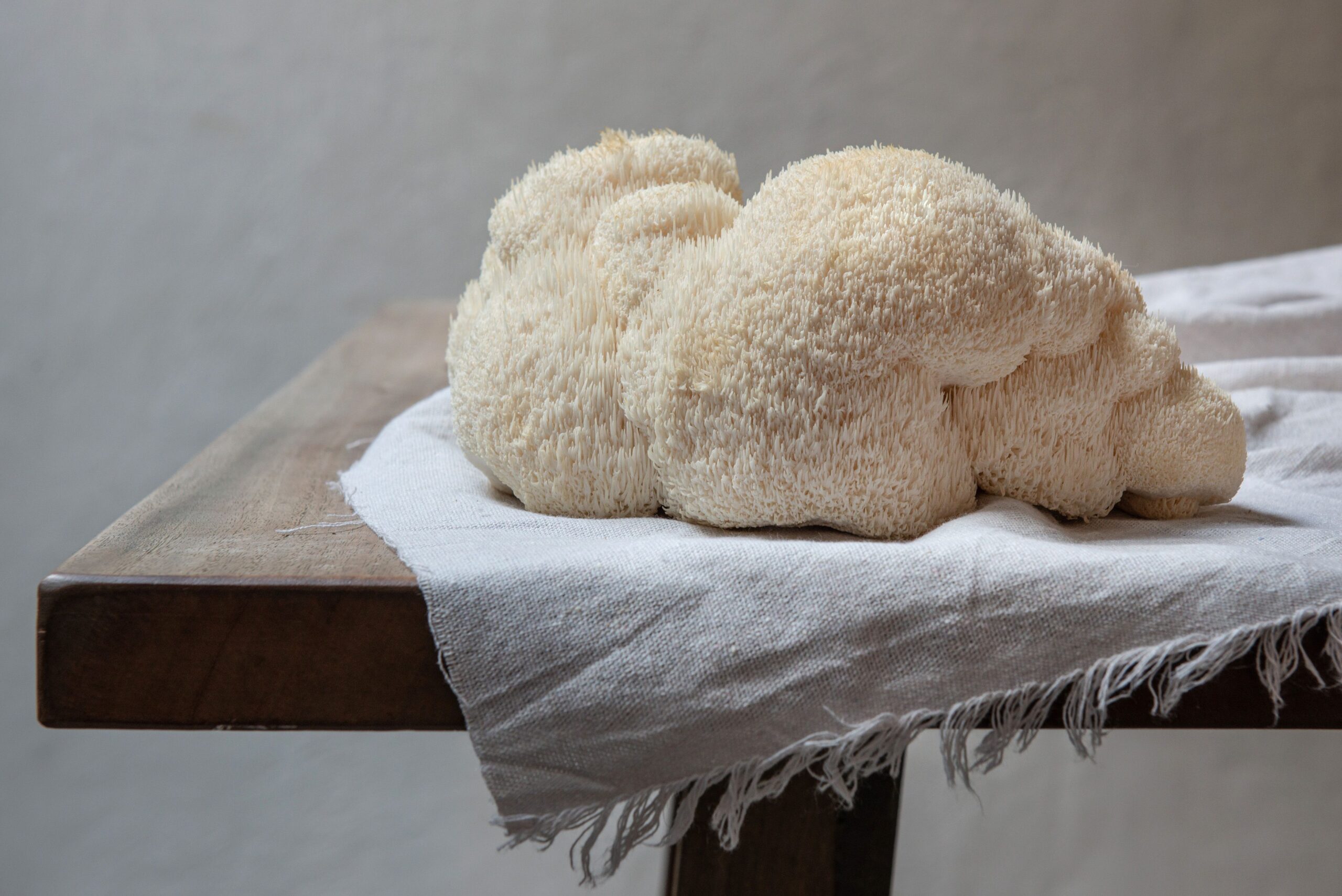
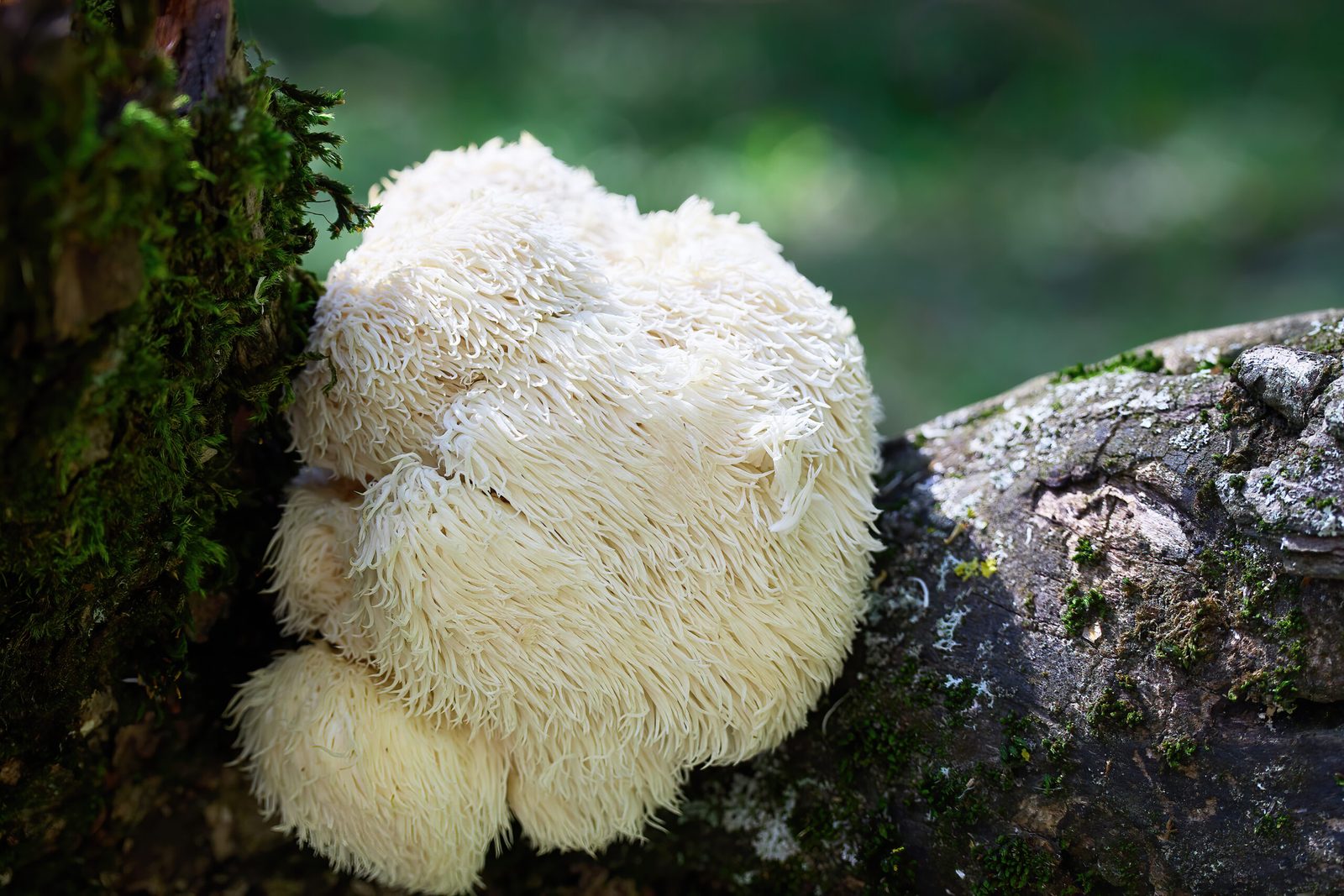
Lion’s mane is a real, edible mushroom. Its scientific name is Hericium erinaceus, and in English it also goes by bearded tooth fungus, bearded hedgehog and hedgehog mushroom. The common name comes from how it looks: not a classic cap-and-stem mushroom, but a rounded white body from which soft spines hang downward like an unkempt mane — or a frozen waterfall.
Fruiting bodies range from 5 to 40 centimetres across, with spines of one to five centimetres or longer. The snow-white flesh yellows with age and eventually browns.
It is native to the deciduous forests of the Northern Hemisphere, across both North America and Eurasia, growing on dead or wounded hardwoods — most often beech, oak and maple. It is not a prolific fungus: a single wound in a tree may fruit the same individual for years.
What few people know
In Europe, lion’s mane is rare and threatened. It is red-listed in several European countries because of poor germination and establishment. In the United Kingdom it is legally protected under Schedule 8 of the Wildlife and Countryside Act 1981 — picking it in the wild is an offence. Everything sold as lion’s mane is therefore cultivated; commercial cultivation began in China in 1988.
In the kitchen it has long been prized. Its dense, fibrous texture is often compared to crab or scallop, and young specimens are considered the best. On a dry-weight basis it contains roughly 22% protein, 57% carbohydrate (about 8% of that as dietary fibre) and 4% fat.
The culture behind the name: yamabushitake and monkey head
Lion’s mane was not discovered in 2020. It has been a known ingredient in East Asia for centuries, and its names say a lot about how it was regarded.
In Japan it is yamabushitake (山伏茸). The yamabushi are the mountain ascetics of the Shugendō tradition — monks who withdrew into the mountains to practise. The mushroom’s hanging spines reminded people of the ornaments on their ceremonial garments.
In China it is hóutóugū (猴头菇), “monkey head mushroom”, after the silhouette of a young, compact fruiting body. It has long been considered a delicacy in Chinese cuisine.
It is worth pausing here. A long tradition is genuinely interesting, and it is a good reason to study an ingredient seriously. But tradition on its own is not evidence. That people have eaten something for centuries tells us little about what it does in the body. For that you need research — which is exactly why we went and read it.
What’s inside: the chemistry, in plain English
Scientific interest in lion’s mane rests on three groups of compounds. If you read only this section, you will already know more than most buyers.
Hericenones — in the fruiting body
Hericenones are aromatic compounds isolated from the fruiting body — the visible mushroom itself. Hirokazu Kawagishi and colleagues described them in the early 1990s; hericenones C, D and E stimulated nerve growth factor (NGF) synthesis in cell culture.
Erinacines — in the mycelium
Erinacines are diterpenoid compounds found not in the fruiting body but in the mycelium — the underground, root-like network of threads. Erinacine A is the most studied of them; lyophilised samples have been measured at around 105–150 µg/g.
Beta-glucans — the structural framework
Beta-glucans are the polysaccharides that make up fungal cell walls. They are the most widely studied mushroom-derived compounds in general and — crucially for buying decisions — they can be measured in a laboratory. A serious manufacturer can tell you what percentage beta-glucan their product contains. We will come back to that.
The NGF story — and where marketing outruns the science
Behind nearly every lion’s mane advertisement sits the same chain of reasoning: the mushroom stimulates NGF → NGF grows nerve cells → therefore the mushroom improves your brain.
Let’s look honestly at where that chain is strong and where it breaks.
NGF (nerve growth factor) is a real, thoroughly documented protein. Rita Levi-Montalcini and Stanley Cohen shared the 1986 Nobel Prize in Medicine for discovering it. Its role in the survival and maintenance of neurons is not in dispute.
It is also true that hericenones and erinacines increased NGF production in cell culture. Multiple independent laboratories have confirmed this.
The chain strains at the point almost nobody examines: the blood–brain barrier. For a compound to affect the brain, it first has to get there.
What the literature says
Erinacine A: after oral administration in rats, it was detectable in brain tissue within one hour. Researchers describe passive diffusion across the blood–brain barrier as the dominant transport mechanism. (Brandalise et al., Journal of Fungi, 2023)
Hericenones: the equivalent evidence is missing. A 2025 review states that hericenones “failed to cross the blood–brain barrier”, and that the in vivo neuroprotective role of hericenones from the fruiting body remains “controversial” in the literature. (Cornford & Charnley, Nutrition Research Reviews, 2025)
This does not make the fruiting body worthless — we will get to that. It means that the “NGF boost” line printed on most products rests on cell-culture and rodent data, not human evidence. Selling that as a human effect crosses a line.
What the human trials actually show
This is the section we wrote this article for. We worked from the original publications rather than summaries. Where a trial found nothing — or measured worse performance — we say so.
Mori et al., 2009
Japan · Phytotherapy Research
Participants30 adults, aged 50–80, with mild cognitive impairment
Dose and form3 g/day dried fruiting body powder (96% tablets)
Duration16 weeks + 4-week follow-up
OutcomeSignificantly higher HDS-R scores at weeks 8, 12 and 16. Four weeks after stopping, scores fell significantly.
Nagano et al., 2010
Japan · Biomedical Research
Participants30 women
Dose and form2 g/day fruiting body, baked into cookies
Duration4 weeks
OutcomeLower depression (CES-D) and indefinite complaints (ICI) scores versus baseline.
Saitsu et al., 2019
Japan · Biomedical Research
Participants31 healthy adults over 50
Dose and formFruiting body supplement
Duration12 weeks
OutcomeOnly one of three tests (MMSE) improved significantly. Benton and S-PA showed no difference.
Li et al., 2020
Taiwan · Frontiers in Aging Neuroscience
Participants41 completers with mild Alzheimer’s disease
Dose and form1,050 mg/day erinacine A-enriched mycelia
Duration49 weeks
OutcomeMMSE improved (21.75 → 23.2; p=0.035). Daily-living scores (IADL) significantly better than placebo (p=0.012). CASI did not reach significance (p=0.058). Manufacturer-funded.
Docherty et al., 2023
United Kingdom · Nutrients
Participants41 healthy adults, aged 18–45
Dose and form1.8 g/day mushroom complex
DurationAcute (60 min) + 28 days
OutcomeFaster Stroop reaction time 60 minutes post-dose (p=0.005). But fewer words recalled (p=0.013). The reduction in stress scores did not reach significance (p=0.051).
Surendran et al., 2025
United Kingdom · Frontiers in Nutrition
Participants18 healthy adults, mean age 22.8
Dose and form3 g of a 10:1 fruiting body extract, single dose
DurationAcute (90 min)
OutcomeNo effect on global cognition or mood. Fine motor scores improved; Flanker and TMT-B scores got worse.
How to read all this
Four things stand out when you put the trials side by side.
1. Most positive findings came from people who had room to improve. Mild cognitive impairment, early Alzheimer’s, older participants. The trials in young healthy adults — Docherty 2023, Surendran 2025 — produced mixed or null results. That is logical: if you are already near ceiling on a test, improvement is hard to detect.
2. The effect did not persist. The most important and least quoted detail of the Mori trial: four weeks after participants stopped, their scores fell significantly. If there is an effect, it is tied to continued intake.
3. The sample sizes are very small. Eighteen, thirty, thirty-one, forty-one. These are pilot studies. Licensing a medicine would require thousands of participants.
4. The preparations are not comparable. One trial used dried fruiting body powder, another erinacine A-enriched mycelium, a third a 10:1 extract. Chemically these are different products. The Taiwanese result cannot simply be transferred to a fruiting body powder — or the other way round.
The honest summary
A 2025 systematic review (Menon et al.) screened 26 studies — of which only nine were in humans: five randomised controlled trials and three pilot trials. The Alzheimer’s Drug Discovery Foundation’s independent assessment puts it plainly: the clinical trials “have included small numbers of participants with short durations of treatment.”
So the fair way to put it is this: lion’s mane is promising, seriously researched, and not yet proven in humans. Anyone claiming more than that is not citing the literature.
Fruiting body or mycelium? The difference that matters
If you take one practical thing away from this article, make it this.
The fruiting body is the mushroom itself: the part you pick, dry and grind. The mycelium is the thread-like network that grows through the substrate.
The problem is not mycelium as such. The problem is how much of the market produces it: the mycelium is grown on grain — usually rice or oats — and then the whole thing is dried and milled together. This is known as myceliated grain. A substantial part of the finished powder is therefore starch, not mushroom.
Hence the most common label sleight of hand. Many products state a “polysaccharide content” — but starch is also a polysaccharide. A high polysaccharide figure can simply mean a lot of rice. Which is why you should ask for beta-glucan content, not polysaccharides.
So is mycelium bad?
No — and the nuance matters. Most articles skip it.
Erinacines exist only in the mycelium, and erinacine A is precisely the compound with the best blood–brain barrier data we have. The 49-week Taiwanese Alzheimer’s trial used enriched mycelium, not fruiting body.
The fair distinction is therefore not “fruiting body good, mycelium bad”. It is this: grain-grown mycelium milled together with its substrate is the problem — not mycelium cultivated under controlled conditions and deliberately enriched for erinacine A, which is an entirely different category of product.
The European legal difference
There is a purely legal dimension here that is worth knowing as a buyer in the EU.
- Fruiting body and hot-water extract: not novel food. The EU Novel Food Catalogue records consumption in the Union before 15 May 1997, so no pre-market authorisation is required.
- Dehydrated mycelium powder: classified as novel food, because there is no established history of significant consumption in the EU before 1997. It requires authorisation under Regulation (EU) 2015/2283.
- Ethanol and dual extracts: the catalogue specifically names only the aqueous extract powder, leaving the status of these less clear-cut.
In practice: if a product sold in Europe contains mycelium powder, you are entitled to ask about its authorisation.
How to read a label: extraction, ratios and beta-glucans
Why raw powder isn’t enough
Fungal cell walls are made of chitin — the same material as insect shells. Human digestion does not break it down efficiently. If the cell wall does not open, much of what is inside passes through untouched.
This is why hot-water extraction is the professional baseline: a long extraction held near boiling point, opening the cell wall and taking the beta-glucans into solution. A dual extraction (water plus ethanol) additionally recovers compounds that are not water-soluble, such as terpenoids.
What does “10:1” mean?
In principle, that 10 kg of raw material yielded 1 kg of extract. In practice the number guarantees nothing on its own, because it says nothing about what was concentrated. A high ratio can sit alongside a low beta-glucan content.
An extract ratio is a marketing figure. A beta-glucan percentage is a measurement. They are not the same thing.
Checklist before you buy
- Does it say fruiting body or mycelium? If it doesn’t say, that is itself an answer.
- Does it state a beta-glucan percentage — not just “polysaccharides”?
- Is the actual milligram amount per serving given, rather than a “mushroom blend”?
- Is the extraction method named (hot water, dual)?
- If mycelium: was it grown on grain? Does it hold EU novel food authorisation?
- Is there third-party lab testing, and will they send it on request?
- Does the brand promise specific health effects? In the EU that is unlawful — and a warning sign.
Safety and side effects
Lion’s mane has a favourable safety profile on the available data — but not a flawless one, and the full picture is part of honest information.
LiverTox, the database maintained by the US National Institutes of Health, assigns lion’s mane a likelihood score of “E”: an unlikely cause of clinically apparent liver injury. The monograph states that “there have been no case reports of clinically apparent liver injury attributed to lion’s mane.”
In clinical trials the most common issues were mild gastrointestinal complaints — abdominal discomfort, nausea, diarrhoea — typically in fewer than 10% of participants. In the 49-week Taiwanese trial, four participants withdrew because of abdominal discomfort, nausea and skin rash; the overall adverse event rate was 8.2%.
Who should be cautious?
- Anyone with a mushroom allergy. Mushroom sensitivity is not unusual, and a hypersensitivity reaction to lion’s mane has been documented.
- Pregnant and breastfeeding women. Not because harm is established — because there is not enough data. That alone justifies caution.
- People on anticoagulants, or before planned surgery. Interaction data is thin, so speak to a doctor first.
- Anyone under medical treatment. Lion’s mane is not a medicine and does not replace treatment. For any clinical question, a doctor is the right address — not a blog post.
Lion’s mane and coffee — why the two work together
There is a practical argument here that follows directly from the research and is rarely made.
The key lesson of the Mori trial was not that scores improved — it was that they fell again once people stopped. If there is an effect, it depends on consistency. And consistency is the hardest part of any supplement: people forget capsules.
They do not forget their morning coffee. Coffee is already a daily ritual — there is no new habit to build around it. That is the strongest, purely logistical argument for putting lion’s mane in coffee.
Doesn’t heat destroy it?
For beta-glucans the answer is surprisingly simple: the standard extraction method is itself hot water, held near boiling for hours. Beta-glucans are recovered using heat. Brewing at 92–96 °C therefore does not destroy them; it does much the same thing a laboratory would.
On the thermal stability of hericenones specifically, however, there is not enough published data to make a confident claim. We would rather write that down than work around it.
The real problem with mushroom coffee
It isn’t the mushroom. It’s the coffee.
Most of the category is built on instant coffee, because blending powder with powder is the easy route. The result is cheap and quick to produce — usually drinkable, rarely good. Anyone who cares about coffee tastes the difference immediately. And so most people’s experience of the category ends the same way: “I tried it once and never finished the bag.”
A product you don’t drink cannot do anything for you. Coffee quality here is not an aesthetic question — it is the precondition for the whole thing working at all.
Why we promise nothing — and why that’s good news
If you’ve read this far, you’ll have noticed we never wrote “lion’s mane improves memory” or “sharpens focus”.
There are two reasons, and both are worth stating.
The first is legal. In the European Union, Regulation (EC) 1924/2006 governs what may be claimed about a food in health terms. Only authorised claims may be used. For lion’s mane — as for most botanical and fungal ingredients — no health claim has been authorised. Roughly two thousand botanical claims have sat “on hold” pending assessment for years. A brand advertising a specific effect is not being bold; it is breaking the law.
The second is simpler. We don’t know. As you saw above: nine human trials, sample sizes between eighteen and forty-one, mixed results. You cannot honestly build a promise on that — and we don’t want to.
What we do know precisely, and state plainly, is what is in the bag, how much, where it came from and how it was made. That is what a premium brand can actually guarantee. The rest we leave to the researchers.
Frequently asked questions about lion’s mane
What is lion’s mane mushroom?
Lion’s mane is the common English name for Hericium erinaceus, an edible mushroom also known as bearded tooth fungus or hedgehog mushroom. It grows on dead and wounded hardwoods across North America and Eurasia.
How long does lion’s mane take to work?
In the longer trials, measurable changes generally appeared after 8 to 16 weeks of consistent intake. Acute single-dose experiments showed no consistent effect. Anyone promising immediate results is not citing the literature.
What is a typical daily dose?
Clinical trials have used between 1 and 3 grams per day depending on the form. There is no officially established recommended intake — dosing varies by preparation, and different forms are not comparable.
Can you take lion’s mane every day?
Trials have used daily intake for periods from 4 to 49 weeks without serious adverse events. Mild gastrointestinal complaints occurred in fewer than 10% of participants. If you have a mushroom allergy, are pregnant or breastfeeding, or take medication, speak to a doctor first.
Is fruiting body or mycelium better?
They contain different compounds: hericenones are in the fruiting body, erinacines in the mycelium. The real distinction is not between the two but whether the mycelium was grown on grain — much of such a product is starch. In the EU, dehydrated mycelium powder is additionally classified as a novel food requiring authorisation.
Does brewing destroy lion’s mane compounds?
Beta-glucans are recovered using hot water in the standard extraction process, so brewing temperatures do not degrade them. For hericenones specifically, there is not enough published thermal stability data to say.
Does lion’s mane contain caffeine?
No. Lion’s mane is a mushroom and contains no caffeine. In a lion’s mane coffee, all the caffeine comes from the coffee.
Is it legal to sell lion’s mane in the EU?
Yes. The fruiting body and hot-water extract are not novel foods, as consumption in the Union predates 15 May 1997. Dehydrated mycelium powder, by contrast, is a novel food requiring authorisation under Regulation (EU) 2015/2283.
If you’ve made it this far
You now know more about lion’s mane than most of the people selling it.
You know it is a real mushroom, rare and legally protected in parts of Europe. You know hericenones sit in the fruiting body and erinacines in the mycelium, and that the blood–brain barrier is the weakest link in the story. You know there are nine human trials, that several returned mixed results, and that the effect faded once intake stopped. You know what to ask about a label.
With that, you can decide for yourself what is worth buying — from us or from anyone else.
Pilessavio Coffee Club
Whole bean mushroom coffee — no compromises
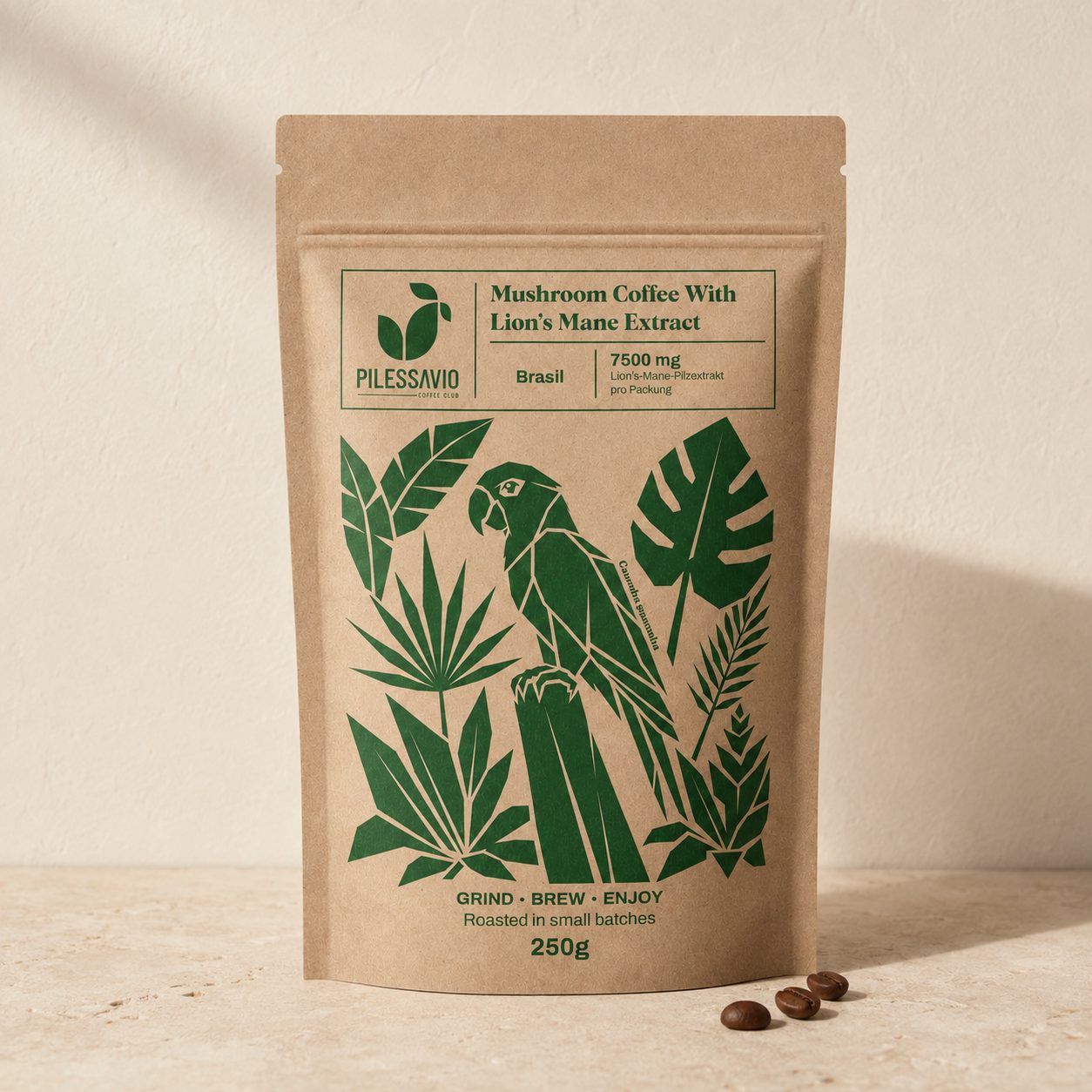
Brazilian arabica roasted in small 10 kg batches, with lion’s mane extract. Not instant. Not flavoured. Not a ten-ingredient blend. A coffee you would happily drink even if there were no mushroom in it — which was exactly the point.
- 300 mg lion’s mane fruiting body extract per 10 g serving
- 7,500 mg lion’s mane per 250 g pouch
- Premium Brazilian arabica, whole bean
- Small-batch roasting, 10 kg at a time
- 100% home-compostable packaging
We promise no health effect — for the reasons explained above. We promise you will know exactly what is in your cup.
View on Amazon →If you want to go deeper, the Pilessavio Journal covers specialty coffee, roasting and functional ingredients. Our FAQ has the product details, and About Us explains why we started this in the first place.
Sources
- Mori K. et al. Improving effects of the mushroom Yamabushitake (Hericium erinaceus) on mild cognitive impairment: a double-blind placebo-controlled clinical trial. Phytotherapy Research, 2009. DOI: 10.1002/ptr.2634
- Nagano M. et al. Reduction of depression and anxiety by 4 weeks Hericium erinaceus intake. Biomedical Research, 2010;31(4):231–237. J-STAGE
- Saitsu Y. et al. Improvement of cognitive functions by oral intake of Hericium erinaceus. Biomedical Research, 2019;40(4):125–131. DOI: 10.2220/biomedres.40.125
- Li I-C. et al. Prevention of Early Alzheimer’s Disease by Erinacine A-Enriched Hericium erinaceus Mycelia Pilot Double-Blind Placebo-Controlled Study. Frontiers in Aging Neuroscience, 2020;12:155. DOI: 10.3389/fnagi.2020.00155
- Docherty S., Doughty F.L., Smith E.F. The Acute and Chronic Effects of Lion’s Mane Mushroom Supplementation on Cognitive Function, Stress and Mood in Young Adults. Nutrients, 2023;15(22):4842. DOI: 10.3390/nu15224842
- Surendran G. et al. Acute effects of a standardised extract of Hericium erinaceus on cognition and mood in healthy younger adults. Frontiers in Nutrition, 2025;12:1405796. DOI: 10.3389/fnut.2025.1405796
- Cornford N., Charnley M. Hericium erinaceus: a possible future therapeutic treatment for the prevention and delayed progression of Alzheimer’s disease? Nutrition Research Reviews, 2025;38(2):613–627.
- Brandalise F., Roda E. et al. Hericium erinaceus in Neurodegenerative Diseases: From Bench to Bedside and Beyond. Journal of Fungi, 2023;9(5):551. DOI: 10.3390/jof9050551
- Menon et al. Benefits, side effects, and uses of Hericium erinaceus as a supplement: a systematic review. Frontiers in Nutrition, 2025.
- Kawagishi H., Zhuang C., Shnyreva A. Hericenones and erinacines: stimulators of nerve growth factor (NGF) biosynthesis in Hericium erinaceus. Mycology, 2010. DOI: 10.1080/21501201003735556
- LiverTox: Clinical and Research Information on Drug-Induced Liver Injury — Lion’s Mane. National Institute of Diabetes and Digestive and Kidney Diseases. NCBI Bookshelf
- Alzheimer’s Drug Discovery Foundation — Cognitive Vitality: Lion’s Mane. alzdiscovery.org
- European Commission — Novel Food Catalogue, Hericium erinaceus. Regulation (EU) 2015/2283 and Regulation (EC) 1924/2006.
Disclaimer: This article is for information and education. It is not medical advice and does not replace professional examination, diagnosis or treatment. Pilessavio Coffee Club products are foods, not medicines, and are not intended to prevent, treat or cure any disease. The research cited here comes from the scientific literature and does not constitute a claim about Pilessavio products. For any health question, consult a doctor.